

Custom Software Development · August 25, 2026
Custom Software Development Trends in 2026: How AI, Automation and Agentic Workflows Are Transforming Businesses
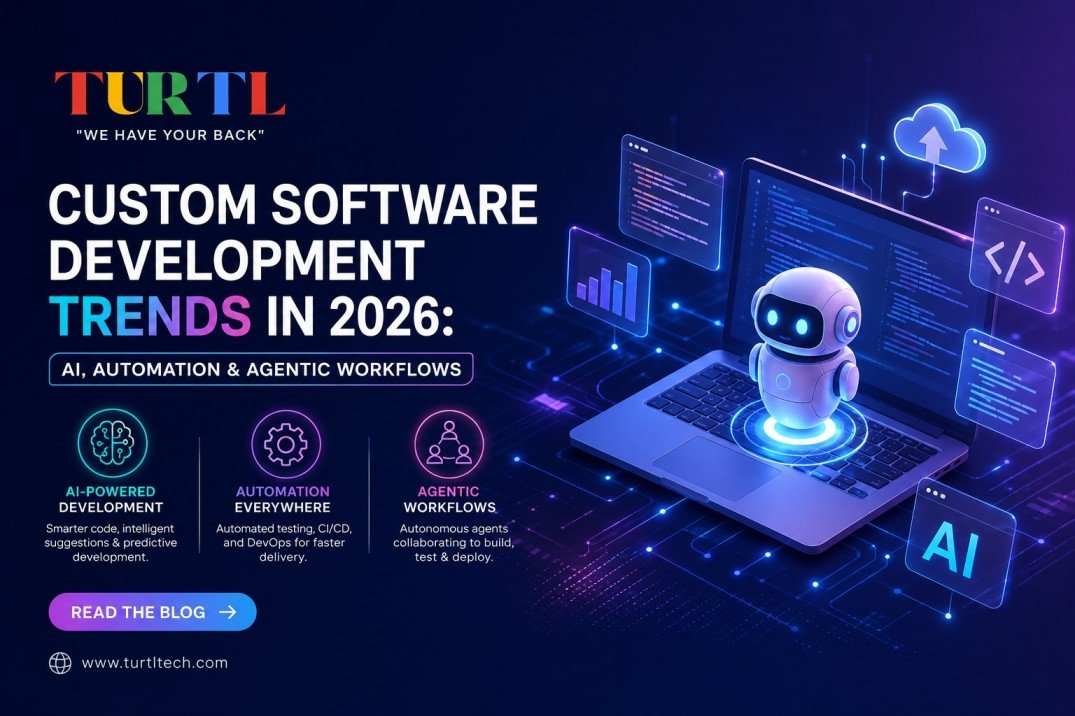
Software is no longer just a tool for storing information or managing everyday business tasks. In 2026, businesses are expecting much more from their technology. Companies are looking for software that can automate repetitive work, connect different systems, understand business data, support employees and help teams make faster and better decisions.
This shift is making custom software development increasingly important for businesses with unique workflows, specialized requirements and long-term technology goals. Instead of forcing employees to change the way they work to fit generic software, companies can build software around their actual processes, customers and operational requirements.
Artificial intelligence, intelligent automation, agentic workflows, API integrations and software modernization are changing the way modern business applications are designed. But the most important trend is not simply adding new technology. It is using technology to solve real business problems and create measurable improvements.
So, what are the biggest custom software development trends in 2026, and how can businesses use them to improve efficiency, productivity and long-term growth?
What Are the Biggest Custom Software Development Trends in 2026?
The biggest custom software development trends in 2026 include AI-powered applications, intelligent business process automation, agentic AI workflows, connected business systems, legacy software modernization, AI security and a stronger focus on measurable business outcomes.
These trends are making business software more intelligent, connected and adaptable. Businesses are moving beyond applications that simply store information and are increasingly adopting software that can process information, automate workflows, connect systems and support employees in making better decisions.
The key is not to adopt every new technology simply because it is popular. Businesses should identify the processes that create the biggest challenges and then determine where custom software, AI, automation or modernization can create the greatest value.
AI-Powered Custom Software Is Becoming More Practical
Artificial intelligence has moved beyond experimentation and is becoming a practical part of modern business software. Companies are increasingly exploring AI software development to process information, analyze data, summarize documents, improve customer service, support employees and automate repetitive activities.
For example, a company receiving hundreds of customer enquiries every day may traditionally use software to record and organize those enquiries. An AI-powered application can go further by understanding the customer's request, identifying the type of enquiry, retrieving relevant information and helping the employee determine the next step.
This does not necessarily mean removing people from the process. Instead, AI can handle repetitive information-processing tasks while employees focus on activities that require judgment, communication and experience.
This is where custom AI software development can create real business value. Rather than adding AI simply because it is a current trend, businesses can identify specific workflows where artificial intelligence can improve efficiency, accuracy, customer experience or decision-making.
For companies exploring these opportunities, choosing the right custom software development company is important because successful AI implementation starts with understanding the business problem, existing systems, data and desired outcome.
Businesses interested in learning more about TurtlTech can explore our software development company in India page.
Intelligent Business Process Automation Is Changing Operations
Business process automation has been used by organizations for many years, but the combination of artificial intelligence and automation is creating new possibilities. Traditional automation works particularly well when a process follows predefined rules. For example, once an order is approved, software can automatically update inventory, create a record or notify another system.
Many modern business processes, however, contain information that is not structured. Customer emails, documents, support requests and written messages may need to be understood before the correct action can be taken. This is where AI automation can make workflows more intelligent.
An AI-powered workflow could receive a customer request, understand the nature of the enquiry, retrieve relevant information and route the request to the appropriate employee or system. Instead of employees spending time manually sorting information and moving data between applications, software can handle more of the repetitive work.
For businesses considering business process automation, the objective should not simply be to automate as many tasks as possible. The better approach is to identify where employees are spending unnecessary time and determine which parts of the workflow can be improved through automation.
Agentic AI Is Moving Software From Answers to Actions
One of the most important developments in artificial intelligence in 2026 is the growth of agentic AI. Traditional AI assistants are generally designed to answer questions, generate content or provide information. Agentic systems can be designed to work toward a defined objective by completing multiple steps and interacting with approved tools or software systems.
For example, an AI-powered business workflow could receive a request, check customer information, retrieve data from an internal system, prepare a recommendation and create the next task. This creates new possibilities for AI workflow automation, where artificial intelligence becomes part of an operational process rather than remaining a separate chatbot.
However, businesses should approach agentic AI carefully. Not every process should be fully automated. Sensitive information, financial activities and high-impact decisions may require human approval, appropriate permissions and monitoring.
The opportunity is therefore not simply to make software autonomous. It is to create controlled and intelligent workflows where AI, automation and human expertise work together.
Businesses Are Connecting Their Existing Software
Growing businesses rarely operate with a single software platform. A company may use separate systems for CRM, sales, accounting, inventory, customer support, HR and reporting.
Each platform may perform its own function effectively, but problems can appear when these systems cannot communicate with one another. Employees may have to manually transfer information from one application to another or maintain spreadsheets to connect different systems. This can create unnecessary work, duplicate information and avoidable errors.
API integration and custom software development can help businesses create a more connected technology environment. Instead of replacing every existing platform, companies can connect the systems that already perform important functions.
For example, customer information from a CRM can be connected with an internal application, inventory system, accounting platform and reporting environment. Information can then move between systems according to defined business rules. This can reduce manual data entry and give employees better access to relevant information.
Legacy Software Modernization Is Becoming a Strategic Priority
Many organizations still depend on software that was developed years ago. These systems may continue to perform important business functions, but they can become increasingly difficult to maintain, integrate or scale as technology requirements change.
This can become a major challenge when a company wants to introduce artificial intelligence, automation or modern cloud technologies. Replacing an entire legacy application is not always practical. Existing software may contain important business logic, historical data and workflows that the organization cannot simply abandon.
This is where legacy software modernization can provide a more practical path forward. Depending on the system, modernization may involve updating specific components, improving architecture, introducing APIs, restructuring data, upgrading technologies or gradually replacing outdated modules.
Modernization can also help businesses prepare for AI adoption. AI-powered applications depend on reliable data and effective access to business systems. When important information is stored across disconnected or outdated applications, creating reliable AI workflows becomes more difficult.
Custom Software Development Is Becoming More ROI-Focused
Software development is increasingly being evaluated by the business value it creates rather than simply by the number of features delivered. Business leaders want to know whether a technology investment can reduce operational costs, save employee time, improve customer response, reduce errors or provide better visibility into business operations.
For example, a company may spend hundreds of employee hours every month preparing reports manually. A custom reporting application could automate much of that process and provide employees with faster access to important information.
The value of the software is not simply the dashboard itself. The value comes from the time saved and the improvement in operational efficiency. This is why modern custom software development services should be connected to measurable business objectives.
AI Security and Governance Are Becoming Essential
As artificial intelligence becomes more deeply integrated into business software, security and governance become increasingly important. An AI-powered application may have access to customer information, internal documents, databases or other business systems. This creates important questions about data access, permissions and the actions an AI system should be allowed to perform.
Businesses need to understand what information an AI system can access, what actions it can perform, which activities require human approval and how sensitive information is protected.
Businesses investing in AI software development should consider authentication, access control, data protection, monitoring and appropriate human oversight as part of the overall solution.
Human and AI Collaboration Will Shape Modern Business Software
AI is often discussed as a replacement for human work, but many businesses may benefit more from combining artificial intelligence with human expertise. AI can process large amounts of information quickly, while people can provide context, judgment, experience and accountability.
For example, AI can prepare a recommendation while an employee makes the final decision. It can draft a customer response while a support specialist reviews it. It can identify unusual activity while an experienced employee investigates the issue.
Instead of asking whether AI will replace employees, businesses should consider which tasks software can handle efficiently and where human expertise creates the most value.
Custom Software vs SaaS: Which Is Better?
SaaS and ready-made software remain excellent options for businesses with standard requirements. A company that needs common CRM, accounting, communication or project management features may find that an existing SaaS platform provides everything it needs without the time and investment involved in building custom software.
The situation can be different when a business has specialized workflows, complex integrations or requirements that standard software cannot support effectively. In these situations, custom software can provide greater flexibility and control because the system can be designed around the company's actual processes.
There is no universal answer. The right choice depends on the organization's business requirements, budget, operational complexity, integration needs and long-term growth plans.
Businesses Are Preparing for AI-Ready Software
Another important trend in 2026 is the move toward software architectures that can support future AI capabilities. A business may not need advanced AI today, but its technology requirements can change as artificial intelligence becomes more integrated into everyday operations.
Modern software architecture can make future AI adoption easier when it includes reliable APIs, well-structured business data, scalable infrastructure, clear business rules and appropriate access controls. This approach can reduce the need for major redevelopment when new technologies or business processes are introduced.
What Should Businesses Do About These 2026 Software Trends?
Businesses should not adopt every new technology simply because it is trending. The better approach is to start with the business problem and then determine which technology can provide the most practical solution.
Companies should identify processes that consume significant employee time, look for repetitive manual tasks, review disconnected systems and examine applications that are becoming difficult to maintain. Once these challenges are identified, businesses can determine whether custom software development, AI, automation, API integration or software modernization can create a meaningful improvement.
How TurtlTech Helps Businesses Build Custom Software
At TurtlTech, we believe software should be designed around the business rather than forcing the business to change its workflow to fit the software.
TurtlTech helps businesses explore solutions involving custom software development, AI software development, business process automation, API integration, web application development, mobile app development, CRM and ERP development, and legacy software modernization. The objective is to create software that is practical, scalable and aligned with the way the business operates.
Frequently Asked Questions
What are the biggest custom software development trends in 2026?
The biggest trends include AI-powered software, intelligent business automation, agentic AI workflows, API integration, legacy software modernization, AI security and a stronger focus on measurable business outcomes.
How is AI changing custom software development?
AI is helping businesses process information, automate repetitive work, support decision-making and create more intelligent workflows. Its greatest value comes when AI is connected to a real business process rather than being added simply as a standalone feature.
What is agentic AI?
Agentic AI refers to AI systems designed to work toward a defined objective by completing multiple steps and interacting with approved tools or software systems. In business environments, agentic AI can support workflows while operating within defined permissions and appropriate human oversight.
Is custom software better than SaaS?
Not always. SaaS can be a good choice for businesses with standard requirements, while custom software may be more suitable for companies with unique workflows, specialized functionality or complex integrations.
Can AI be integrated into existing business software?
Yes. AI can often be integrated into existing applications through APIs, custom development or software modernization. The best approach depends on the existing technology, data architecture and business requirements.
When should a business consider custom software development?
A business should consider custom software when existing applications cannot efficiently support important workflows, manual processes are creating operational problems or multiple systems need to communicate with one another.
How much does custom software development cost?
The cost depends on the project's complexity, required features, integrations, technology, security requirements and development scope. A detailed requirements analysis is normally needed before an accurate development estimate can be provided.
Conclusion
The future of custom software development in 2026 is not simply about adopting the newest technology. It is about using technology more intelligently to solve real business problems.
AI can help businesses understand information and support decision-making. Automation can reduce repetitive work. Agentic workflows can help software participate in multi-step processes. API integrations can connect disconnected systems, while modernization can prepare existing applications for new technologies.
If your business is dealing with manual processes, disconnected systems, outdated software or workflows that no longer scale, custom software development may provide a more effective path forward.
Build Software Around Your Business With TurtlTech
Talk to TurtlTech about your software requirements and explore how custom software, AI and automation can help your business operate more efficiently and prepare for future growth.
Discuss Your Custom Software Project