

App Development · November 10, 2026
The App Without an App Store: Why Smart Businesses Are Rethinking Mobile Experiences in 2026
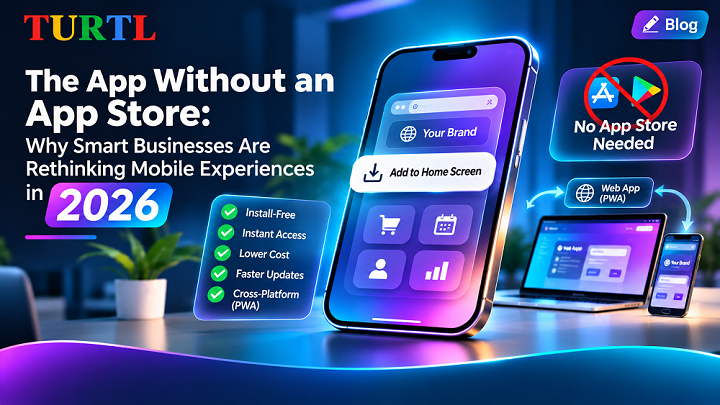
What if your customers could access an app-like experience directly from your website without searching an app store first?
Mobile applications have changed how businesses connect with customers. From online shopping to appointment booking, people increasingly expect convenient digital experiences on their smartphones.
However, developing and maintaining separate Android and iOS applications is not always the most practical solution.
Businesses must consider development budgets, application updates, distribution requirements and the effort customers make before installing another app.
That is why Progressive Web Apps, commonly known as PWAs, deserve a closer look in 2026.
PWAs combine modern web technology with selected app-like features, helping businesses deliver convenient mobile experiences through the browser.
What Is a Progressive Web App?
A Progressive Web App is a web application designed to provide an experience that can resemble an installed application.
Users can access a PWA through a website link, just like a normal web page.
Depending on their browser and operating system, they may also be able to install it on their device's home screen or application launcher.
Some PWAs support offline access to previously cached content, notifications, responsive layouts and full-screen experiences.
These capabilities depend on browser support, device permissions and the implementation.
A PWA is not simply a responsive website. It is a web application designed with progressive enhancement, reliability and, where supported, installability in mind.
Why Businesses Are Rethinking Traditional Mobile Apps
Traditional mobile applications remain valuable, but they introduce challenges that organizations should evaluate carefully.
Development and Maintenance Costs
Building separate native applications may require different platform-specific development work.
Companies also need to maintain compatibility with operating system updates, test multiple devices and manage releases.
A PWA can allow much of the experience to be developed and maintained through a shared web codebase.
This can reduce duplicated development work for suitable projects, although the total cost still depends on functionality, integrations and complexity.
Friction During Customer Onboarding
Every additional step between a customer discovering a service and using it creates an opportunity for abandonment.
A conventional mobile app may require users to visit an app store, download the application, install it and complete onboarding.
A PWA can begin with a simple website link.
For services that customers use occasionally, this convenience can be particularly attractive.
Multiple Devices and Screen Sizes
Customers access digital services through smartphones, tablets, laptops and desktop computers.
A well-designed PWA can deliver a consistent interface across these devices while adapting to different screen sizes and input methods.
This makes PWAs especially interesting for businesses that want a connected web and mobile experience.
Seven Business Benefits of Progressive Web Apps
1. Faster Access to Digital Services
Customers can open a PWA directly from a URL.
For businesses offering booking, ordering, account management or customer support, reducing access friction can improve the user journey.
2. A Shared Development Foundation
A shared application architecture can simplify maintenance and feature development.
Instead of independently maintaining every interface, development teams can reuse components, business logic and APIs.
3. App-Like User Experiences
PWAs can support responsive interfaces, home-screen installation and streamlined navigation.
When implemented correctly, the experience can feel more integrated than a traditional website.
4. Flexible Updates
Most web application updates can be deployed through the website infrastructure without requiring customers to download a new store-distributed package.
Developers must still manage caching carefully so users receive compatible versions.
5. Search Engine Discoverability
Publicly accessible PWA pages can be indexed by search engines when implemented with crawlable content and appropriate technical SEO.
This gives eligible content the discovery advantages of the web.
However, installing a PWA does not automatically improve search rankings.
6. Offline Capabilities
Service workers can enable applications to cache selected resources and support limited offline functionality.
For example, a field service application may allow employees to view previously synchronized information during a temporary connection outage.
The system can then synchronize permitted changes when connectivity returns, provided this behavior has been designed and tested.
7. Potentially Lower Distribution Barriers
PWAs can be distributed through direct links without requiring a traditional app-store listing.
Some can also be packaged for app-store distribution when that approach serves the business.
Progressive Web App vs. Native Mobile App
Choosing between a PWA and a native application depends on what the business needs.
A PWA may be a strong choice when the priorities include accessible web-based services, simplified deployment, cross-device compatibility and a shared codebase.
A native mobile app may be preferable when the project requires specialized device capabilities, intensive graphics performance, deeper platform integration or particular app-store distribution features.
A hybrid or cross-platform approach may also be appropriate.
The correct decision should come from a technical assessment rather than a blanket assumption that one technology is always better.
Where PWAs Make Business Sense
E-Commerce and Retail
Customers can browse products, manage accounts, review orders and complete purchases through a mobile-friendly application.
A PWA can provide a consistent shopping experience while making product pages accessible through search.
Healthcare Appointment Platforms
A healthcare organization could use a PWA for appointment requests, clinic information and patient-facing administrative services.
Any handling of sensitive patient information requires appropriate privacy, security and regulatory controls.
Education and Learning Platforms
Educational institutions can develop web-based student dashboards, course portals and learning management tools accessible across devices.
Field Sales and Service Teams
Employees who regularly work outside an office can benefit from simplified mobile access to tasks, customer information and reporting interfaces.
Restaurants and Hospitality
Businesses can create accessible ordering, reservation, loyalty and customer-service experiences without requiring every customer to install a separate native app.
What Makes a High-Quality PWA?
An effective PWA requires more than adding an installation button.
The development process should address:
- Responsive UI/UX design: Navigation, forms and interactions must work across screen sizes.
- Performance optimization: Pages should load efficiently, even under challenging network conditions.
- HTTPS and security: Sensitive interactions require secure connections and properly protected backend services.
- Web app manifest: Application metadata helps compatible browsers present an installed experience.
- Caching strategy: Offline resources and updates must be handled correctly to avoid stale or inconsistent information.
- Accessibility: The application should support keyboard navigation, readable content and appropriate assistive technologies.
- Analytics: Businesses need visibility into engagement, task completion and user experience.
Browser and operating-system testing are essential because PWA capabilities are not identical across every platform.
How TurtlTech Approaches Modern Web Applications
At TurtlTech, we focus on building web applications around business requirements rather than technology trends alone.
A successful mobile experience begins with understanding users, identifying essential features and selecting an architecture that supports future improvements.
Our web development and PWA services can support the design and implementation of responsive interfaces, application workflows, backend integrations and performance-focused digital experiences.
Whether your organization needs a customer portal, internal dashboard or commerce application, the goal is to choose an appropriate development strategy.
Are PWAs the Future of Mobile Development?
PWAs are an important part of the mobile application ecosystem, but they are not a universal replacement for native apps.
The strongest long-term approach is to select technologies that match user expectations, technical needs and business objectives.
For many organizations, that means evaluating PWAs alongside native and cross-platform applications before committing to development.
Frequently Asked Questions
Can users install a PWA without visiting an app store?
Yes, on supported browsers and devices. The installation process and available capabilities vary by platform.
Do Progressive Web Apps work offline?
They can support selected offline functionality when appropriate caching and data synchronization are implemented.
Are PWAs cheaper than native apps?
They may reduce development and maintenance duplication for suitable projects, but actual savings depend on the application requirements.
Can a PWA send push notifications?
Push notifications are supported in some browser and operating-system environments, subject to technical conditions and user permissions. Support should be verified for the intended audience.
Is a PWA suitable for an e-commerce business?
Yes. PWAs can support product browsing, customer accounts, checkout and other e-commerce features when integrated with appropriate backend services.
Build a Better Mobile Experience with TurtlTech
Your customers should not have to struggle to access your digital services.
TurtlTech helps businesses develop responsive websites, Progressive Web Apps and custom mobile applications built around usability, performance and scalability.
Ready to explore the right application technology for your business?
Discuss your project with our development team and find out whether a PWA, native app or custom web application best fits your goals.
- Explore our services: https://turtltech.com/pwa-development.html
- Email: info@turtltech.com
- Call: +91 9958040595