

Cloud Computing · November 20, 2026
The Hidden Cost of Cloud Computing and How Smart Businesses Can Take Back Control
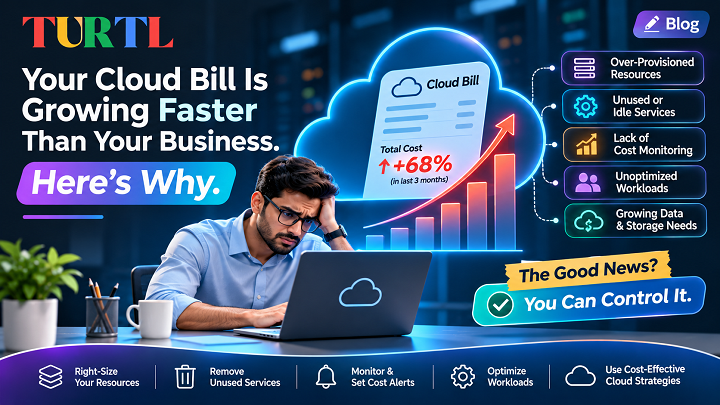
Cloud computing was supposed to make technology simpler, faster, and more affordable. Businesses moved away from traditional servers and invested in flexible cloud infrastructure, expecting greater scalability and improved operational efficiency.
But today, many organizations face an unexpected challenge: their cloud expenses keep increasing, even when their business growth remains relatively stable.
The cloud has not necessarily become the problem. The real issue is often how cloud resources are configured, monitored, managed, and optimized.
Businesses sometimes pay for services they rarely use, maintain servers that run unnecessarily, or deploy applications without considering long-term infrastructure costs.
The result? Growing monthly bills, unpredictable technology expenses, and valuable budgets consumed by avoidable inefficiencies.
Let's explore why this happens and what businesses can do about it.
1. Why Are Cloud Computing Costs Increasing?
Cloud platforms such as Amazon Web Services (AWS), Microsoft Azure, and Google Cloud offer flexible infrastructure that can support businesses of almost any size.
However, flexibility also creates responsibility.
Unlike traditional infrastructure, where organizations purchase equipment upfront, cloud computing often follows a consumption-based pricing model.
That means costs depend on the computing power, storage, network traffic, databases, and additional services your applications consume. Several common issues contribute to increasing cloud expenses.
Overprovisioned Cloud Resources
Businesses frequently allocate more CPU, memory, or storage than their applications require.
For example, a company may operate a large virtual machine designed for peak traffic even when normal utilization is relatively low.
This creates unnecessary spending without delivering meaningful business value.
Idle Servers and Unused Resources
Development environments, testing servers, unattached storage volumes, and inactive databases can continue generating charges.
Without regular audits, these forgotten resources accumulate and increase the monthly cloud bill.
Inefficient Application Architecture
An application that makes unnecessary database requests, transfers excessive data, or repeatedly performs expensive computations may consume more infrastructure resources than needed.
In these cases, the most effective cost reduction may require improving application code or architecture—often through targeted software development or modernization—rather than purchasing a cheaper hosting plan.
Uncontrolled Data Storage
Cloud storage expenses can increase when businesses retain outdated backups, duplicate files, unnecessary logs, and inactive datasets indefinitely.
A clearly defined data retention and storage lifecycle policy helps control these expenses.
2. The Hidden Expenses Most Businesses Overlook
Cloud invoices often contain more than basic server charges. Organizations may also pay for:
- Data transfers between regions and services.
- Load balancers and networking resources.
- Managed database instances and backups.
- Monitoring, logging, and security services.
- Container orchestration and associated infrastructure.
- Third-party cloud marketplace applications.
- AI processing, model inference, and specialized computing workloads.
These costs are not automatically wasteful. Many are essential for performance, reliability, and security.
The goal is to understand which expenses create business value and which can be reduced safely.
3. What Is FinOps, and Why Does It Matter?
FinOps, short for Cloud Financial Operations, is a collaborative approach to managing technology spending.
It brings finance, engineering, product, and business teams together to improve cost visibility, accountability, and decision-making.
Instead of asking only, "How much did we spend on cloud services?", FinOps encourages a better question:
"What business value did we receive from that spending?"
According to the FinOps Foundation's State of FinOps 2026 report, workload optimization and waste reduction remain major priorities for organizations managing cloud expenditure.
The discipline is also expanding beyond traditional cloud expenses to include AI, software subscriptions, licensing, and other technology investments.
For growing businesses, adopting FinOps principles can help make infrastructure costs more predictable and measurable.
4. Seven Practical Ways to Reduce Cloud Costs
1. Conduct a Complete Cloud Cost Audit
Review every active service and identify unused, oversized, or unnecessary resources. Start with high-spending accounts, environments, and workloads.
2. Right-Size Your Infrastructure
Analyze actual CPU, memory, and application utilization. Select infrastructure resources that meet real workload requirements instead of relying on assumptions.
3. Implement Autoscaling
Autoscaling adjusts computing capacity according to application demand. It can help businesses avoid maintaining peak-level capacity throughout periods of low activity.
4. Optimize Storage and Backups
Move suitable infrequently accessed data to lower-cost storage tiers. Apply retention policies carefully, ensuring that business continuity and compliance requirements remain protected.
5. Use Appropriate Pricing Commitments
Reserved capacity, savings plans, or committed-use discounts may reduce costs for predictable workloads. However, commitments should be based on reliable usage forecasts to avoid paying for unused capacity.
6. Improve Application Performance
Review slow database queries, unnecessary API calls, inefficient caching, and excessive background processing. Better engineering can reduce the computing resources required to deliver the same service.
7. Set Budgets and Automated Alerts
Use cloud cost management tools to monitor expenditure. Set spending thresholds, track usage anomalies, and assign cost ownership to the relevant teams.
5. Cloud Cost Optimization Is More Than Cutting Expenses
The cheapest infrastructure is not always the best infrastructure. Aggressive cost-cutting can create performance issues, reduce reliability, or weaken disaster recovery capabilities.
A good optimization strategy balances four important factors:
- Performance: Can applications respond quickly under expected workloads?
- Scalability: Can infrastructure support increased customer activity?
- Security: Are systems protected through appropriate access controls, updates, and monitoring?
- Cost efficiency: Is the business paying for resources that provide measurable value?
The objective is not simply to spend less. It is to spend intelligently.
6. A Practical Cloud Optimization Example
Consider a hypothetical e-commerce company running production servers continuously, maintaining multiple development environments, and storing years of logs in expensive storage tiers.
The business notices that its infrastructure bill is increasing even though order volume has remained stable. A cloud assessment identifies several opportunities:
- Schedule non-production resources during working hours where appropriate.
- Reduce oversized compute instances after performance testing.
- Apply lifecycle rules to older logs.
- Improve database queries and caching.
- Introduce cost allocation tags for better reporting.
The business can then measure potential savings against performance and operational requirements before implementing changes.
Actual savings depend on the architecture, workload, provider pricing, and existing infrastructure.
7. How TurtlTech Helps Businesses Optimize Cloud Infrastructure
At TurtlTech, we approach cloud computing as a business investment rather than simply a hosting requirement.
Our cloud services focus on helping organizations design, manage, and improve infrastructure that supports their operational goals. Our capabilities include:
- Cloud infrastructure assessment and planning.
- AWS, Azure, and Google Cloud migration strategies.
- Infrastructure architecture and optimization.
- DevOps and deployment automation.
- Cloud cost visibility and resource planning.
- Performance monitoring and infrastructure management.
Whether your organization is migrating to the cloud or reviewing an existing environment, the first step is understanding what your workloads actually need.
Frequently Asked Questions
Why is my cloud bill increasing every month?
Common reasons include overprovisioned resources, growing storage requirements, idle infrastructure, data transfer charges, and inefficient application workloads.
Can a business reduce cloud costs without affecting performance?
Often, yes. Careful right-sizing, utilization analysis, storage optimization, and application improvements can reduce unnecessary spending while preserving required performance.
What is the difference between cloud management and FinOps?
Cloud management focuses on operating and maintaining infrastructure. FinOps focuses on financial accountability, spending visibility, and the business value of technology consumption. The two disciplines complement each other.
Should every business use multiple cloud providers?
Not necessarily. Multi-cloud strategies introduce additional complexity. The right choice depends on business requirements, resilience needs, technical capabilities, and cost.
Final Thoughts: Your Cloud Should Support Growth, Not Consume It
Cloud computing remains an important foundation for digital business operations. However, unmanaged infrastructure can gradually become a financial burden.
Businesses that regularly review consumption, improve architecture, and implement cost governance are better positioned to control spending without compromising scalability.
The most effective cloud strategy is not about using the most resources. It is about using the right resources.
Ready to Take Control of Your Cloud Costs?
Stop guessing where your infrastructure budget is going.
Connect with TurtlTech to discuss your cloud environment, identify optimization opportunities, and plan infrastructure around your business objectives.
- Explore Our Cloud Computing Services: https://turtltech.com/cloud-computing.html
- Email: info@turtltech.com
- Phone: +91 9958040595
TurtlTech | Smarter Technology. Better Business Outcomes.