

Custom Software Development · August 25, 2026
Why Businesses Are Replacing Generic Software with Custom Solutions in 2026
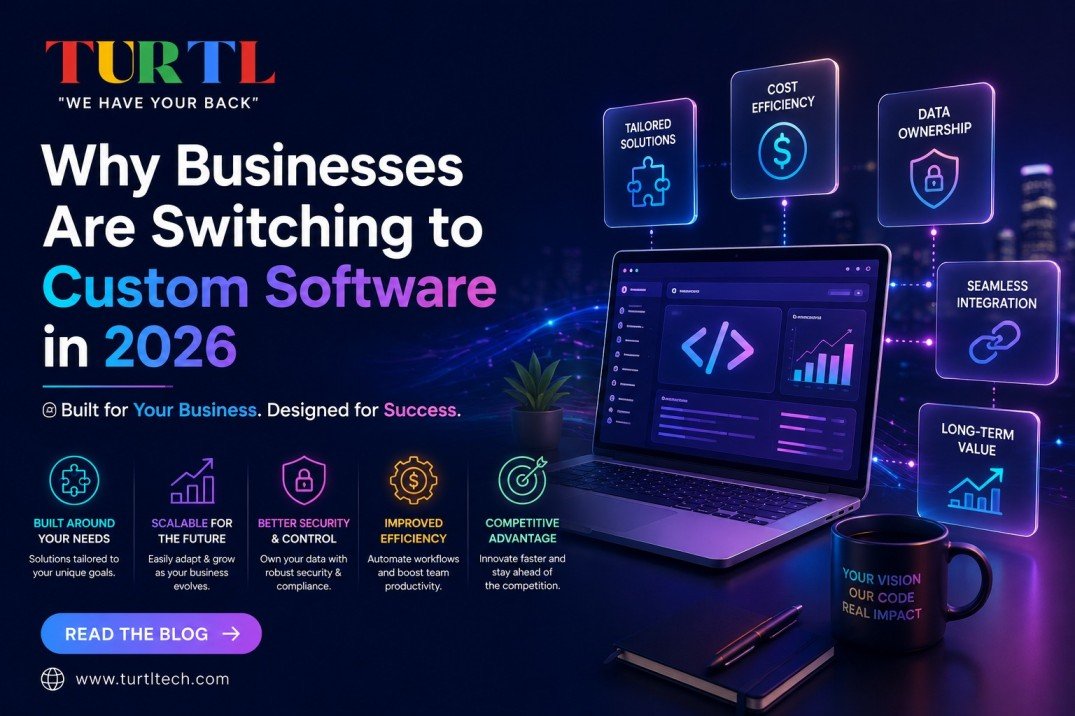
For years, buying ready-made software was the obvious choice for most businesses. It was faster to deploy, easier to understand and usually less expensive than building a system from scratch. For many standard business requirements, that approach still makes perfect sense.
But something has changed.
As businesses grow, their processes become more complex. Teams need different systems to communicate with each other, customers expect faster service, employees need real-time information, and artificial intelligence is changing what businesses expect their software to do.
A tool that worked perfectly when a company had ten employees may become frustrating when the business has fifty, five hundred or more. The problem is not always that the software is bad. The problem is that the software was designed for a general market, while the business has developed its own way of working.
That is why more businesses in 2026 are asking a different question: Should we continue adapting our business to generic software, or should we build software around the way our business actually works?
For companies with specialized workflows, complex integrations, growing operational requirements or ambitious AI and automation plans, custom software development is becoming a much more practical option.
Why Are Businesses Moving Away From Generic Software in 2026?
Businesses are not replacing generic software simply because custom software is a newer technology. The bigger reason is that the cost of working around software limitations can become greater than the cost of solving the underlying problem.
A company may start with one CRM, another application for accounting, a spreadsheet for internal tracking and another platform for customer communication. Each tool may work reasonably well on its own. Over time, however, employees may spend more time moving information between systems than actually using that information.
This creates what can be called operational friction. The software is technically working, but the business is constantly working around the software.
A sales team may have to enter the same customer information into multiple systems. An operations team may depend on spreadsheets because the existing application cannot handle a particular workflow. Management may wait for manually prepared reports because important data is spread across different platforms.
At some point, businesses start asking whether the technology is actually helping them operate more efficiently. That is often the point where custom software solutions become worth considering.
Generic Software Works Well Until Your Business Becomes Different
Generic software is designed to serve a broad group of users. That is one of its biggest strengths. A standard CRM, accounting platform, project management system or HR application can provide common functionality without requiring a business to build everything itself.
The limitation appears when a company's processes become different from the assumptions built into the software.
Imagine a logistics company with a very specific delivery approval process. A standard platform may support orders, customers and deliveries, but it may not support the company's exact approval rules, pricing structure, regional workflow and reporting requirements.
The company then starts adding workarounds. Employees maintain spreadsheets. Custom fields are added. Third-party tools are connected. Manual processes are introduced. People develop their own methods for getting information from one system into another.
The software remains in place, but the overall technology environment becomes increasingly complicated. This is one of the biggest reasons businesses consider custom business software in 2026. The goal is not to build something simply because custom software sounds better. The goal is to remove unnecessary friction.
The Hidden Cost of Generic Software
The monthly subscription price of software is only one part of its cost. Businesses should also consider the time employees spend working around limitations, the cost of multiple integrations, duplicate data entry, unused features, additional user licenses, manual reporting and the operational delays caused by disconnected systems.
A company might have several SaaS subscriptions that appear inexpensive individually. When combined, however, the organization may be paying for multiple platforms while still relying on spreadsheets and manual processes.
There can also be a less visible cost: the cost of changing your business process to fit the software. If employees have to follow an inefficient workflow simply because the application does not support the preferred process, the business may lose productivity every day.
This does not mean every SaaS subscription is a problem. Far from it. Standard SaaS products are often the right choice for common business functions. The important question is whether the software is reducing complexity or creating more of it.
Custom Software Gives Businesses More Control Over Their Workflows
The biggest advantage of custom software development is control. Instead of starting with a predefined set of features and asking how the business can adapt to them, custom development starts with the business requirements.
How does the company currently work? Where are employees losing time? Which processes are unique? Which systems need to communicate? What information does management need? What should happen automatically? What will the business need as it grows?
These questions form the foundation of a custom software solution. The result can be an application designed around the organization's actual workflow rather than a generic workflow designed for thousands of unrelated businesses.
That can be particularly valuable for companies operating in industries where processes, regulations, customer journeys or internal workflows are highly specialized.
AI Is Changing the Build-vs-Buy Decision
Artificial intelligence is one of the biggest reasons the conversation around custom software is changing in 2026. Traditional software generally waits for users to enter information and follow predefined workflows. AI-powered software can understand information, identify patterns, summarize content, recommend actions and support more flexible workflows.
This creates opportunities that generic software may not always support in the exact way a business requires. For example, a business may want an AI system that understands its internal documents, customer records, business rules and operational processes. Instead of simply adding a generic AI chatbot, the company may need an application connected to its own systems and workflows.
That is where AI software development and custom applications become particularly relevant. The value is not the AI model alone. The value comes from connecting AI to the right data, systems, permissions and business processes. Recent enterprise technology discussions increasingly point toward this combination of AI, custom workflows and modernization rather than treating AI as a standalone feature.
AI Automation Can Turn Repetitive Work Into Intelligent Workflows
Many businesses still depend on employees to move information between applications, review documents, classify enquiries, prepare reports and perform repetitive administrative tasks.
Traditional automation can solve some of these problems when the process follows predictable rules. AI automation can expand what is possible when the process involves unstructured information.
A customer email can be analyzed and categorized. A document can be processed and its important information extracted. A support request can be understood and routed to the appropriate team. A business report can be generated from information stored across connected systems.
This creates a more intelligent form of business process automation. For companies, the important question is not "Where can we add AI?" It is: "Which business processes would become significantly better if software could understand and act on information more intelligently?" That question leads to better technology decisions.
Agentic Workflows Are Making Custom Software More Powerful
Another major development in 2026 is the growing interest in agentic AI and AI-powered workflows. A traditional application may require a user to perform several steps manually. An agentic workflow can potentially coordinate multiple approved actions toward a defined goal.
For example, instead of an employee checking a customer request, opening a CRM, searching for information, checking an internal system and creating a follow-up task, a properly designed AI workflow could assist with several of these steps.
The employee can remain responsible for decisions that require human judgment while the software handles repetitive coordination. This creates an important opportunity for custom AI workflow automation. The business can define what the system is allowed to access, which actions it can perform and when human approval is required.
That level of control is difficult to achieve when every business process is forced into the same generic workflow.
Integration Is Becoming Just as Important as the Software Itself
One of the biggest problems businesses face is not a lack of software. It is too much disconnected software.
A company might have CRM software, accounting software, inventory management, customer support, marketing tools and internal applications. If these systems do not communicate effectively, employees become the bridge between them. That is expensive.
API integration and custom software development can connect these systems and create a more consistent flow of information. For example, a new customer could be added to the CRM, automatically create the required internal records, trigger an onboarding workflow and make relevant information available to the appropriate departments.
Instead of employees repeatedly entering the same information, the systems can communicate according to predefined business rules. This is one reason businesses increasingly look at custom software as an integration layer rather than simply another application.
Businesses Are Looking for Software That Can Scale With Them
A business rarely remains the same size. Customers increase. Employees increase. Products change. New locations are added. New regulations appear. New services are introduced.
Generic software may support some of this growth, but there can come a point where its limitations become increasingly visible. Custom software can be designed with the company's future requirements in mind. That does not mean predicting everything the business will ever need. It means creating a flexible foundation that can evolve as requirements change.
A scalable application can make it easier to introduce new workflows, integrate additional systems, add user roles, support new business units and incorporate new technologies. For businesses planning long-term digital transformation, this flexibility can become a significant advantage.
Security and Data Control Are Becoming More Important
Data has become one of the most valuable assets for modern businesses. Customer information, financial records, internal documents, operational data and proprietary business processes may all need to be protected.
With generic platforms, businesses often have to work within the security architecture, permissions and data structures provided by the vendor. Custom software can provide greater control over how specific business data is handled, who can access it and how different systems interact.
This does not automatically make custom software more secure. Poorly designed custom software can create serious security risks. The advantage comes when security is considered as part of the architecture from the beginning. For businesses using AI, this becomes even more important because AI-powered applications may interact with sensitive information and business systems.
Custom Software Can Create a Competitive Advantage
One of the strongest reasons to invest in custom software is differentiation. If every competitor uses the same software and follows similar workflows, technology may provide little competitive advantage.
But if a company develops a better way to manage customers, automate operations, deliver services or analyze information, software can become part of the company's competitive strategy.
A logistics company might build a specialized tracking platform. A manufacturer might develop software around its production workflow. A healthcare organization might create a customized patient management system. A financial business might automate a complex approval process.
In each case, the software is not simply supporting the business. The software becomes part of how the business operates and differentiates itself.
Custom Software Does Not Mean Replacing Everything
One common misunderstanding is that choosing custom software means throwing away every existing system. That is rarely necessary.
A better approach can be a hybrid software strategy. A business might keep its accounting platform, CRM or other proven SaaS products while building a custom application that connects them. In another situation, the business might modernize only the most problematic part of an existing system.
This approach can reduce disruption while solving the specific problems that are creating the most operational friction. The right question is not: "Should we replace all our software?" The better question is: "Which parts of our technology environment should we buy, which should we integrate, and which should we build?" That is the modern build vs buy decision.
When Should a Business Consider Custom Software?
Custom software may be worth considering when a business has workflows that standard applications cannot support efficiently, employees are spending significant time on manual processes, multiple systems need to communicate, or software limitations are affecting customer experience and growth.
It can also make sense when the business has a process that provides competitive differentiation and therefore should not be forced into a generic industry workflow.
However, custom software is not automatically the right choice for every company. If a business needs standard accounting, email marketing, basic project management or common collaboration features, a proven SaaS product may be more practical. The decision should be based on business requirements, not on the assumption that custom software is always better.
How to Know If Your Business Has Outgrown Generic Software
There are several signs that a company may have reached this point. Employees may repeatedly enter the same information into different systems. Teams may maintain spreadsheets because the existing software cannot handle an important process. Managers may depend on manually prepared reports. Employees may use multiple applications just to complete one workflow.
Another sign is when the business starts changing its processes simply because the software cannot support the way the organization needs to operate. If workarounds have become normal, the software may no longer be serving the business as effectively as it once did.
That does not automatically mean the company needs a completely new platform. It does mean that a technology review is probably worthwhile.
How Much Does Custom Software Development Cost?
There is no single price for custom software development services because the cost depends on what the software needs to accomplish. A simple internal application with a few workflows will require a very different investment from a large enterprise platform with multiple integrations, AI capabilities, complex security requirements and thousands of users.
The development cost can be influenced by functionality, user roles, integrations, technology stack, UI/UX requirements, security, infrastructure, AI requirements, testing and ongoing maintenance.
Instead of choosing a software development company based only on the lowest initial quote, businesses should consider the total value of the solution and the problem it is expected to solve. A well-designed system that saves hundreds of employee hours every month may provide significantly more value than a cheaper application that creates new operational limitations.
What Should Businesses Look for in a Custom Software Development Company?
Choosing the right custom software development company is as important as choosing the technology itself. Businesses should look for a development partner that understands requirements before discussing features, can explain technical decisions clearly, understands integrations and security, and has a process for testing and maintaining the software after launch.
A strong development partner should also be willing to challenge unnecessary requirements. More features do not automatically mean better software. The goal should be to build the right solution for the business.
Companies should also evaluate whether the development team can work with modern technologies such as AI, cloud platforms, APIs, automation and scalable application architectures when those technologies are actually relevant to the project.
How TurtlTech Helps Businesses Move Beyond Generic Software
At TurtlTech, we believe business software should support the way a company actually works. Businesses should not have to redesign their entire workflow simply to fit the limitations of a generic application.
TurtlTech helps businesses explore custom software development, AI software development, business process automation, API integration, web application development, mobile app development, CRM development, ERP development and software modernization based on their specific requirements.
The process starts with understanding the business problem, existing technology environment and desired outcome. From there, the right solution may involve custom development, integration, automation, modernization or a combination of these approaches. The objective is not to build software simply because custom software is available. The objective is to build technology that creates measurable value for the business.
Businesses interested in understanding TurtlTech's approach can also explore our software development company in India page.
Frequently Asked Questions
Why are businesses replacing generic software with custom solutions?
Businesses are increasingly considering custom solutions when generic software no longer fits their workflows, creates excessive manual work, lacks important integrations or limits their ability to scale. Custom software allows the technology to be designed around specific business requirements instead of forcing the business to work around generic limitations.
Is custom software better than generic software?
Not always. Generic software can be the better choice for common business requirements. Custom software becomes more valuable when a company has specialized workflows, complex integrations, unique requirements or processes that provide a competitive advantage.
What are the disadvantages of generic software?
Generic software can become restrictive when a business has requirements that the platform was not designed to support. Businesses may face workflow limitations, disconnected systems, additional subscriptions, manual workarounds, limited customization or difficulty integrating specialized processes.
Why is custom software becoming more popular in 2026?
AI-assisted development, business automation, better integration capabilities and the growing need for specialized digital workflows are making custom software more practical for some businesses. At the same time, companies are increasingly evaluating technology based on business outcomes rather than simply buying more SaaS applications.
Can custom software replace SaaS?
Yes, in some cases, but it does not have to. Businesses can replace a SaaS product with custom software when the existing platform no longer meets important requirements, or they can use a hybrid approach where SaaS products and custom applications work together.
Is custom software more expensive than ready-made software?
The initial development investment is often higher than purchasing a standard SaaS subscription. However, the relevant comparison should include the total cost of ownership, productivity gains, integration costs, manual work and long-term business value.
Can AI be added to custom business software?
Yes. AI can be integrated into custom applications to support document processing, customer service, data analysis, recommendations, workflow automation and other business processes. The appropriate implementation depends on the business requirements, available data and security considerations.
What is the difference between custom software and off-the-shelf software?
Off-the-shelf software is built for a broad market and provides standardized functionality. Custom software is designed specifically around the requirements, workflows and objectives of an individual business or organization.
When should a company build custom software instead of buying software?
A company should consider building custom software when existing products cannot efficiently support an important business process, when multiple systems need complex integration, when manual work is becoming expensive or when specialized software could create a meaningful competitive advantage.
How can a business reduce the risk of custom software development?
Businesses can reduce risk by clearly defining requirements, prioritizing essential functionality, validating the solution early, selecting an experienced development partner, planning integrations and security from the beginning, and using a phased development approach when appropriate.
How do I choose the right custom software development company?
Look for a development partner that understands your business requirements, can handle integrations and security, communicates clearly, provides a realistic development process and can support the software after launch. Technical expertise is important, but understanding the business problem is equally important.
Final Thoughts
The shift from generic software to custom solutions is not about declaring that SaaS or off-the-shelf software is obsolete. It is about recognizing that businesses have different requirements.
A standard platform can be exactly what one company needs and completely unsuitable for another. As organizations grow, automate more processes and adopt AI, the limitations of generic workflows can become more noticeable.
In 2026, the more important question is no longer simply "Which software should we buy?" It is: "What technology will help our business work better?"
For some businesses, the answer will be SaaS. For others, it will be integration or modernization. And for companies with unique workflows, complex requirements or technology that has become a competitive differentiator, custom software development can provide a much better fit.
The goal should always be the same: build or choose technology that makes the business more efficient, more adaptable and better prepared for growth.
Build Software Around Your Business With TurtlTech
If your current software is creating workarounds instead of solving problems, it may be time to rethink your technology strategy. Talk to TurtlTech about your custom software requirements and discover what a solution built around your business could look like.
Discuss Your Custom Software Project